


Business & Compliance
Who Owns AI-Generated Content? Copyright, Ownership & Legal Risks Explained

2.1. The Human Creative Requirement
2.2. Does Writing the AI Prompt Give You Copyright Ownership?
3. Who Owns AI Content Created by an Employee? 4. Who Owns AI Content Created for a Client? 5. Can an AI Platform Claim Rights Over Your Content? 6. What Are the Biggest Copyright Risks of AI Content? 7. Can You Put Copyrighted Content Into an AI Prompt? 8. Legal Risks of AI Images, Videos, and Music 9. Can AI Content Infringe Trademarks?9.1. What If AI Generates False or Misleading Content?
9.2. Should Businesses Disclose AI-Generated Content?
9.3. How Can Businesses Reduce AI Legal Risks?
10. Who May Have Rights in AI Content? 11. What Should an AI Content Ownership Clause Include?11.1. Common Mistakes Businesses Make
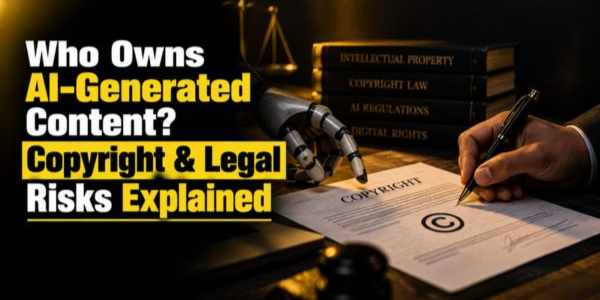
12. AI-Generated Content Legal Risk Checklist 13. ConclusionOwnership of AI-generated content in India depends mainly on how the work was created, how much human creativity was involved, who caused the work to be created, and what the relevant contracts and AI platform terms say. Under Section 2(d)(vi) of the Copyright Act, 1957, the author of a computer-generated literary, dramatic, musical, or artistic work is the person who causes the work to be created. However, fully autonomous AI output may face copyright protection problems because copyright generally requires human creative expression.
Who Owns AI-Generated Content in India?
- First, how was the content created? There is a major difference between entering a short prompt and accepting the first output and spending significant time directing the AI, selecting multiple versions, arranging elements, and substantially editing the final work.
- Second, what human creative contribution was made? A person may add original writing, layout, structure, design elements, editing, or other creative changes to an AI-generated result.
- Third, who caused the work to be created? Section 2(d)(vi) focuses on the person who causes a computer-generated work to be created. The application of this wording to modern generative AI is still developing.
- Fourth, what do the contracts say? Ownership can also depend on agreements between employers and employees, freelancers and clients, and users and AI platforms.
Copyright Act, 1957
Section 2(d)(vi) of the Copyright Act, 1957 states that for a computer-generated literary, dramatic, musical, or artistic work, the author is the person who causes the work to be created. The provision was not written specifically for today's generative AI systems, so questions remain about how it applies to highly autonomous AI tools.
Can AI-Generated Content Be Protected by Copyright?
Not every AI-generated work will qualify for copyright protection. Copyright protection generally depends on original expression and sufficient human creativity. Consider two situations. In the first, a person types, "Write a short story about a dog," and publishes the first response without meaningful changes. The human contribution may be too limited to support a strong claim of copyright over the AI-generated expression. In the second, a writer gives detailed instructions, generates several versions, selects specific portions, restructures the material, rewrites sections, adds original content, and creates a final work through substantial human editing. The human contributions may have a stronger basis for copyright protection.
The Human Creative Requirement
Fully automated output created with minimal human involvement is less likely to receive copyright protection on its own. By contrast, AI-assisted content can have stronger protection where a human arranges, edits, rewrites, selects, or integrates AI material into an original work. For example, an AI-generated photograph may be only raw material. If a designer significantly edits the image, creates a unique composition, combines it with original graphic elements, and develops an original final design, the human-created portions may attract protection.
Does Writing the AI Prompt Give You Copyright Ownership?
Writing a detailed prompt does not automatically make you the copyright owner of the final output. A prompt is generally an instruction to an AI system. Copyright protects expression rather than a simple idea or instruction. Therefore, a person cannot assume that a clever prompt by itself gives them exclusive rights over everything the AI produces. The position can become stronger when prompting forms part of a larger creative process. For example, a creator may write complex prompts, conduct several iterations, select a particular output, rearrange its elements, and substantially modify the result. However, if the AI system makes all the expressive decisions, such as exact wording, pixel placement, visual details, or musical sequencing, the user may not necessarily be treated as the author of those machine-created elements.
Who Owns AI Content Created by an Employee?
Section 17(c) of the Copyright Act, 1957 provides that where a work is made by an employee in the course of employment under a contract of service, the employer is generally considered the first owner, unless the agreement states otherwise.
Businesses should not rely only on general employment rules. They should create clear AI policies covering:
- Ownership: State who owns AI-assisted work created using company resources.
- Approved tools: Identify which AI platforms employees can use.
- Confidentiality: Prevent employees from uploading customer information, confidential documents, trade secrets, or proprietary code into public AI tools.
- Human review: Require employees to check, edit, and verify AI-generated material before publication or delivery.
Who Owns AI Content Created for a Client?
Freelancers, agencies, designers, writers, developers, and marketing professionals often use AI to prepare client deliverables. This creates another ownership issue. A client may expect full ownership of a website, logo, article, advertisement, software product, or other deliverable. But if part of the work is AI-generated and that portion does not qualify for copyright protection, simply saying "all copyright is assigned to the client" may not solve every legal issue.
Client contracts should clearly answer several questions:
- Was generative AI used to prepare the deliverable?
- Which AI tools were used?
- Is the final work being assigned or licensed?
- Who owns the human-created portions?
- Who is responsible if the output infringes another person's copyright or trademark?
- What happens if the AI platform's terms restrict commercial use?
Also Read: Legal Requirements for Websites in India
Can an AI Platform Claim Rights Over Your Content?
Before using an AI platform for commercial work, always read its current Terms of Service.
Different platforms and subscription plans can provide different rights. Some services may allow commercial use, while others may impose restrictions. Terms may also explain how the platform treats user inputs, outputs, training, privacy, and licensing. Many major AI platforms state that users retain rights in their inputs, while paid plans may provide broader rights over generated outputs. However, these terms can differ between services and subscription levels. AI companies can also change their terms. Therefore, businesses should not rely on an old understanding of an AI platform's policy when launching an important commercial project.
What Are the Biggest Copyright Risks of AI Content?
- Substantial Similarity: AI models are trained using large datasets. An output may sometimes resemble an existing protected work. If the result is substantially similar to another person's copyrighted material, commercial use may lead to an infringement claim.
- Prompt-Based Copying: Users may intentionally ask an AI system to reproduce a protected character, image, artwork, or another creator's work. Such instructions can increase legal risk.
- Copyright-Free Assumption: A common mistake is believing that anything created by a machine is automatically copyright-free. AI generation does not remove third-party copyright rights.
Can You Put Copyrighted Content Into an AI Prompt?
Uploading copyrighted books, articles, photographs, designs, databases, software code, or other protected material into an AI system can create legal and confidentiality concerns. Having lawful access to a work does not automatically give you permission to upload it into a third-party AI system. There can also be data security risks. Some public AI services may use inputs under their applicable terms for model improvement or training. Uploading confidential company information, customer records, private financial information, or proprietary code can therefore create serious business risks. Section 52 of the Copyright Act contains specific fair dealing exceptions, including certain uses related to private study, research, criticism, and news reporting. Businesses should not assume that commercial AI use involving copyrighted material automatically qualifies as fair dealing. Before uploading third-party material, check whether you have the required rights or permission.
Legal Risks of AI Images, Videos, and Music
Different forms of AI-generated media create different risks.
- AI-Generated Images: AI images may create copyright concerns if they closely reproduce existing works. There may also be trademark problems where a generated image includes a famous logo, brand identity, product design, or trade dress.
- AI Videos and Deepfakes: AI can generate realistic videos showing people saying or doing things that never happened. Deepfakes can create serious impersonation, deception, privacy, and reputational risks.
- AI Music and Voice Cloning: AI-generated music can accidentally resemble protected melodies, harmonies, or other musical elements. Voice-cloning technology creates additional concerns because a person's distinctive voice can have personal and commercial value.
Can AI Content Infringe Trademarks?
Copyright and trademark rights are separate. An AI-generated work may avoid one type of copyright issue but still create a trademark problem. For example, an AI-generated advertisement may contain a recognizable brand logo, product design, brand name, or trade dress. Publishing such content commercially can potentially result in trademark infringement or passing-off claims. Businesses should therefore conduct trademark checks before using AI-generated logos, names, promotional graphics, packaging concepts, or other branding materials. AI-generated branding should not be treated as automatically safe simply because a machine created it.
What If AI Generates False or Misleading Content?
Generative AI can produce incorrect facts, invented citations, false statements, and other inaccurate information. These errors are commonly described as AI hallucinations. The legal problem begins when such content is published or used commercially without human verification. For example, false statements about a person or competitor can create defamation risks. Incorrect legal or financial information can create professional or regulatory problems. Fake reviews and inaccurate product claims can also create consumer protection and advertising issues. The business or person publishing the material may face legal consequences. Therefore, AI output should never be published blindly, especially in legal, financial, healthcare, advertising, or other sensitive areas.
Every important statistic, quotation, factual claim, legal statement, and product claim should be independently checked before publication.
Should Businesses Disclose AI-Generated Content?
AI disclosure requirements depend on the type of content, the platform, and the context in which it is used. Disclosure is particularly important for synthetic media, deepfakes, advertising, regulated industries, and content that could mislead consumers. Platforms may also have their own rules requiring creators to identify AI-generated or AI-modified material. Businesses should therefore check applicable platform requirements before publishing. For ordinary blogs or social media posts, disclosure may be a recommended best practice depending on the circumstances. For commercial or highly realistic synthetic content, greater transparency can help reduce the risk of misleading audiences.
How Can Businesses Reduce AI Legal Risks?
- Use approved AI tools. Choose platforms that provide suitable privacy protections and commercial usage rights.
- Review the Terms of Service. Check what the relevant plan says about inputs, outputs, commercial use, licensing, privacy, and training.
- Protect confidential information. Employees should not upload customer records, trade secrets, proprietary code, private financial data, or confidential contracts into unapproved AI tools.
- Maintain human review. Human writers, editors, designers, or managers should review and improve important AI-generated material.
- Fact-check content. Verify statistics, legal claims, quotations, names, product claims, and other important information.
- Conduct IP checks. Use reverse-image searches, trademark searches, and other checks before publishing important commercial material.
- Keep records. Save important prompts, iterations, source material, edits, and approvals. These records can help demonstrate the human contribution to the final work.
Who May Have Rights in AI Content?
Party | Possible Role or Claim |
|---|---|
AI User | May claim copyright where they contribute substantial human creativity, arrangement, or editing. |
Human Editor | May own rights in their original edits, structural changes, and added human elements. |
Employer | May own rights to AI-assisted work created by employees within the scope of employment. |
Client | May receive rights through contractual assignments, work-for-hire provisions, or service agreements. |
AI Platform | Determines output usage rights through its Terms of Service and subscription conditions. |
Original Copyright Owner | May have infringement claims if the AI output unlawfully copies protected work. |
Brand Owner | May have trademark claims where logos, names, or trade dress are used without permission. |
What Should an AI Content Ownership Clause Include?
Businesses, agencies, and freelancers should consider adding a dedicated AI clause to their contracts. The clause should define whether work is fully AI-generated or AI-assisted. It should state who owns the final deliverable, who owns or controls relevant prompts, and whether the work is assigned or licensed. The agreement should also identify approved AI tools and require human review and fact-checking before delivery.
Confidentiality provisions should prevent employees or contractors from uploading client trade secrets or sensitive information into unapproved AI systems. Finally, contracts can include indemnity provisions that clearly allocate responsibility if AI-generated material leads to copyright, trademark, or other third-party disputes. Clear contractual terms are especially useful because AI-related ownership can involve several parties at the same time.
Common Mistakes Businesses Make
- Assuming every AI output is automatically free to use.
- Publishing raw AI content without human review.
- Uploading confidential business or client information into public AI tools.
- Ignoring the AI platform's Terms of Service.
- Using AI-generated logos or brand names without trademark checks.
- Publishing fake AI-generated testimonials or customer reviews.
- Failing to address AI usage and ownership in client or freelancer contracts.
AI-Generated Content Legal Risk Checklist
Area | What to Check |
|---|---|
Ownership | Did a human contribute sufficient original expression to claim copyright? |
Copyright | Was the work created without copying existing protected material? |
AI Tool Terms | Do the applicable terms provide the required commercial rights? |
Prompts | Are prompts free from third-party copyrighted or confidential material? |
Similarity | Has the output been checked against existing works? |
Trademarks | Is the output free from unauthorised brand names, logos, or trade dress? |
Accuracy | Have important facts, numbers, quotations, and legal claims been verified? |
Privacy | Does the content respect privacy and avoid unauthorised likenesses or deepfakes? |
Contracts | Do agreements clearly address AI ownership and usage? |
Publication | Does the content meet applicable AI disclosure and platform requirements? |
Also Read: AI Content Legal Issues In India
Conclusion
AI can make content creation faster, but it does not remove copyright and other legal responsibilities. Businesses should check human contribution, platform terms, third-party rights, confidentiality, trademarks, and contracts before using AI content commercially. The safest approach is simple: use AI as a tool, keep meaningful human control, review every important output, and clearly define ownership and responsibility in contracts.
Disclaimer: This blog is for informational purposes only. If you require legal consultation, kindly contact an experienced Corporate Lawyer.
Frequently Asked Questions
Q1. Who owns AI-generated content in India?
It depends on human involvement, the circumstances of creation, and applicable contractual terms. Section 2(d)(vi) identifies the person who causes a computer-generated work to be created as the author, but purely autonomous AI output may not receive copyright protection.
Q2. Can AI-generated content be copyrighted?
No, not automatically. A prompt is generally an instruction. Significant human creative contribution to the final expression is more important.
Q4. Can a business own AI content created by employees?
An employer may own rights in work created by employees within the scope of employment, subject to the applicable agreement and copyright principles.
Q5. Who owns AI content created by an agency?
The agency-client contract should determine ownership, licensing, AI usage, and responsibility for intellectual property verification.

 Get Expert Advice and Solutions
Experienced lawyers for all legal matters wether it is for Family, Property, Criminal Cases, and More
Consult Now