


Business & Compliance
How Can E-commerce Businesses Protect Their Brand From Fake Reviews and Product Copying?
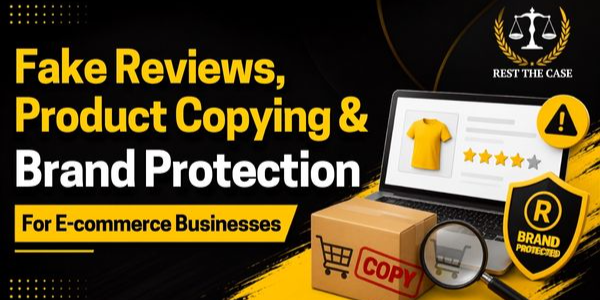

E-commerce businesses can protect their brand from fake reviews, copied products, and unauthorized asset use by registering trademarks, securing copyrights and design rights, preserving evidence, enforcing marketplace takedowns, and pursuing civil or criminal remedies under Indian IP and consumer laws. The appropriate legal approach depends on whether the issue stems from review manipulation, trademark misuse, content theft, design copying, or counterfeit distribution.
How Can an E-commerce Business Protect Its Brand Online?
Protecting an e-commerce brand requires an active enforcement strategy across direct-to-consumer (D2C) channels and multi-vendor marketplaces.
Use this core checklist to protect your digital storefront and IP assets:
- Register Core IP Early: File trademark applications for brand names, logos, slogans, and packaging trade dress. Register copyright for media and file design patents for unique product shapes.
- Establish Brand Registry: Enroll registered trademarks in enforcement systems such as Amazon Brand Registry and Flipkart Brand Verification.
- Watermark Creative Assets: Embed visible logos and invisible metadata into product photography, promotional videos, and graphics.
- Monitor Marketplaces & Review Sections: Run automated scrapers and manual checks to spot fake listings, unauthorized sellers, and sudden review manipulation.
- Document Infringement Evidence: Capture timestamps, URLs, seller IDs, high-resolution screenshots, and test-purchase samples before contacting platforms or infringers.
- Enforce Platform Takedowns: File targeted IP infringement reports through official portal mechanisms.
- Issue Pre-Litigation Legal Notices: Send formal cease-and-desist notices to unauthorized sellers, counterfeiters, or competitors orchestrating malicious review campaigns.
- Pursue Statutory Remedies: Seek court injunctions, damages, and civil or criminal seizures for unaddressed, high-value infringements.
Also Read: How to claim Intellectual property rights
What Can You Do About Fake Reviews of Your E-commerce Business?
Fake reviews corrupt consumer trust and search algorithms. They generally fall into two categories: paid positive reviews generated by competitors for themselves, and malicious negative reviews posted to damage rival sellers.
Under the Consumer Protection Act, 2019 and the Bureau of Indian Standards Guidelines for Online Reviews (IS 19000:2022), e-commerce platforms and sellers are prohibited from publishing fake, unverified, or incentivized consumer feedback.
- Spotting Fake Reviews: Look for unverified purchases, cluster postings within narrow timeframes, generic text, or spikes in 1-star ratings matching competitor product launches.
- Preserving Digital Proof: Document reviewer profile links, order numbers, screenshots, and account creation dates.
- Filing Platform Escalations: Report fake reviews through platform channels (e.g., Amazon Community Guidelines team or Flipkart Seller Support), citing violations of published review standards and IS 19000:2022.
- Publishing Factual Public Responses: Reply professionally to unverified 1-star reviews stating that no matching customer order exists in your system, inviting the buyer to provide invoice details. Avoid emotional or aggressive allegations.
- Pursuing Legal Action for Coordinated Attacks: Where a competitor conducts organized review attacks, issue a legal notice for trade libel, commercial disparagement, and unfair trade practices under the Consumer Protection Act, 2019, escalating to the Central Consumer Protection Authority (CCPA) if necessary.
Also Read: Consumer Protection Laws in India
What Can You Do If Someone Copies Your Product or Listing?
Copying on e-commerce platforms spans multiple distinct legal violations. Choosing the correct remedy requires identifying the specific intellectual property right being infringed.
- Product Photographs & Graphic Media
Stolen product images, infographics, and 3D renders fall under Copyright Infringement. The creator holds automatic copyright protection upon creation under the Copyright Act, 1957.
- Action: File a copyright takedown request with the platform, providing original high-resolution image files, raw metadata, or published D2C URL timestamps.
- Listing Copy & Product Descriptions
Copying written marketing material, sizing charts, or custom product manuals constitutes Copyright Infringement.
- Action: Submit a text-copying notice demonstrating earlier publication dates on your D2C store or catalog filings.
- Packaging & Visual Presentation (Trade Dress)
Imitating a product's distinctive box art, color schemes, and layout to confuse buyers constitutes Passing Off under common law and trademark principles.
- Action: Issue a cease-and-desist letter demanding the immediate withdrawal of confusingly similar packaging.
- Product Shape & Visual Features
Copying the aesthetic design of a physical product requires enforcement under the Designs Act, 2000. If the design holds a valid registration, copying it constitutes Design Piracy.
- Action: File a design infringement notice backed by your Design Certificate.
- Note: Copyright protection does not cover physical product designs produced more than 50 times commercially unless registered under the Designs Act.
What Legal Rights Protect an E-commerce Brand?
Indian intellectual property laws grant distinct protections depending on the asset:
IP Type | Statutory Basis | Protected Assets | Duration of Protection |
|---|---|---|---|
Trademark | Trade Marks Act, 1999 | Brand names, logos, taglines, product line titles, packaging trade dress | 10 years; renewable indefinitely |
Copyright | Copyright Act, 1957 | Product photos, promotional videos, listings, website copy, graphics | Author’s lifetime + applicable statutory period |
Industrial Design | Designs Act, 2000 | Visual shape, surface pattern, ornament, or configuration of a product | Up to 15 years + 5-year extension |
Passing Off | Common Law Principles | Commercial goodwill, unregistered brand marks, visual reputation | Indefinite, subject to proof of reputation and deception |
Trade Secrets | Contract Law / Equity | Vendor lists, sourcing channels, pricing models, manufacturing methods | Governed by confidentiality agreements (NDAs) |
What Can You Do If Someone Sells Counterfeit Products Using Your Brand?
Counterfeiting involves unauthorized third parties manufacturing and selling unauthorized replicas under your registered trademark. This is both a civil violation and a criminal offense under the Trade Marks Act, 1999 and the Bharatiya Nyaya Sanhita, 2023 (BNS).
- Conduct a Documented Test Purchase: Buy the suspected item directly from the infringer listing. Keep the outer courier box, tax invoice, and contents intact.
- Verify Authentication Metrics: Document physical discrepancies, non-compliant packaging, missing batch/serial numbers, or inferior build quality against genuine stock.
- File Counterfeit Complaints on the Marketplace: Submit an infringement notice via the platform's Brand Registry or IP portal, attaching your Trademark Certificate, test-purchase invoice, and side-by-side comparison images.
- Serve a Formal Legal Notice: Demand that the infringing seller immediately halt sales, destroy existing inventory, disclose supply chain sources, and remit earned profits.
- Pursue Civil Injunctions & Criminal Actions: For widespread counterfeiting, file a civil suit under Section 134 of the Trade Marks Act, 1999 to secure ex-parte ad-interim injunctions and John Doe / Anton Piller orders authorizing surprise premises searches and inventory seizures. Alternately, file a criminal complaint under Section 103/104 of the Trade Marks Act read with relevant BNS cheating provisions.
How Can You Get a Copied Product or Fake Listing Removed From a Marketplace?
E-commerce platforms operate under intermediary liability rules governed by Section 79 of the Information Technology Act, 2000. To maintain "safe harbor" protection, platforms must act expeditiously once served with valid actual knowledge of infringement.
- Gather Required Documentation: Prepare your registered Trademark/Copyright/Design registration certificates, official business entity proof, and authorized signatory letters.
- Compile Precise Listing Data: List the exact target ASINs, FNSKUs, web URLs, seller account names, and specific infringement grounds (e.g., unauthorized trademark use in listing title vs. copyright infringement in image #3).
- Submit via Official Portal Channels: Use dedicated portals such as Amazon Intellectual Property Report Form, Flipkart IP Infringement Portal, or Meesho IP Complaints.
- Respond to Counter-Notices: If the seller submits a counter-notice claiming legitimate authorization, prepare to submit formal legal notices or court filings within the platform's required timeframe (often 10–14 days) to prevent listing reinstatement.
What Evidence Should an E-commerce Business Preserve?
Strong documentation is vital for successful IP takedowns and court claims. Maintain a dedicated digital evidence vault containing:
- Original Asset Master Files: Raw camera files (.CR2, .NEF, high-res PNGs), PSD files, vector logo files (.AI, .EPS), and dated design mockups.
- IP Registration Certificates: Issued Trademark Certificates, Copyright Extracts from the Register of Copyrights, and Design Patent Certificates.
- Historical Publication Proof: WayBack Machine archives, D2C launch invoices, domain registration records, and catalog publication dates.
- Infringement Screenshots: Full-screen desktop screenshots showing the infringing listing, active buy-box, seller profile details, pricing, and system clock timestamp.
- Physical Test-Purchase Evidence: Original packaging, shipping labels, tax invoices, courier tracking logs, and physical samples from test purchases.
- Financial Record Logs: Sales reports proving lost revenue, cancelled orders, or advertising budget spikes linked to the infringement window.
How Can E-commerce Businesses Prevent Brand Infringement?
Proactive brand protection limits opportunities for unauthorized sellers and counterfeiters:
- Register Core Trademarks: Secure trademark registrations under relevant international Nice Classification classes (e.g., Class 35 for retail services alongside specific product classes).
- Use Watermarks & Security Seals: Print subtle brand logos on product packaging and apply security holographic stickers or serialized QR codes to physical inventory.
- Execute Authorized Distribution Agreements: Bind distributors, wholesalers, and white-label partners with written contracts prohibiting unauthorized third-party marketplace reselling.
- Publish Official Distribution Directories: Maintain an "Authorized Sellers List" on your D2C website, explicitly clarifying that unauthorized third-party marketplace listings carry no manufacturer warranty.
- Run Automated Tracking Crawlers: Deploy automated software to monitor marketplace catalog changes, new listings matching your brand keywords, and image theft across online platforms.
What Mistakes Should Businesses Avoid When Protecting Their Brand?
- Assuming Registration Automatically Halts Infringements: Trademark and copyright offices do not monitor online marketplaces. Brand owners must actively detect and report violations.
- Submitting Incomplete Takedown Notices: Filing platform reports without precise URLs, registration numbers, or clear comparison proof leads to rejected claims and delays.
- Confusing IP Categories in Filings: Reporting physical product design theft as a "copyright claim" or image theft as a "trademark issue" often results in platform rejection.
- Treating All Negative Feedback as Fake: Reporting genuine customer complaints or critical product reviews as fake damages seller credibility with platform enforcement teams.
- Making Unsubstantiated Legal Threats: Sending baseless cease-and-desist letters without valid registered rights can expose your business to legal actions for groundless threats of legal proceedings under Section 142 of the Trade Marks Act, 1999.
- Neglecting Evidence Preservation Before Notice: Informing an infringer before saving screenshots, downloading catalog data, and completing test purchases allows them to delete evidence and evade liability.
Brand Protection Checklist for E-commerce Businesses
Infringement Risk | Primary Protection Mechanism | Core Evidence Required | Recommended Action |
|---|---|---|---|
Fake Positive/Negative Reviews | IS 19000:2022 & Consumer Protection Act | Review logs, account creation dates, order IDs | Report to platform; CCPA compliance attacks. |
Product Photo / Content Theft | Copyright Act, 1957 | Original raw media files, catalog dates | Submit DMCA platform copyright takedown notice. |
Brand Name / Logo Misuse | Trade Marks Act, 1999 | Registered Trademark Certificate | File Brand Registry takedown; issue notice. |
Counterfeit Product Sales | Trade Marks Act & BNS Provisions | Test purchase invoice, side-by-side comparison | File portal takedown; seek civil/criminal court orders. |
Copied Product Design | Designs Act, 2000 | Registered Design Certificate | Issue cease-and-desist letter; file design infringement action. |
Packaging / Look-alike Copying | Common Law Passing Off / Trade Dress | Market reputation proof, customer confusion data | Issue legal notice for trade dress infringement. |
Unauthorized Resellers | Contractual Distribution Controls | Authorized seller lists, breach of contract proof | Issue distributor breach notice; restrict supply. |
Explore More Legal Guides
Consumer Protection Rules Every E-commerce Business Must Follow
Privacy Policy, Terms & Conditions & Website Policies For E-Commerce Stores
E-Commerce Legal Compliance Checklist For Indian Businesses
10 Legal Documents Every Online Store Must Have
Conclusion
A strong fraud-prevention framework helps businesses reduce losses from fake orders, delivery refusals, empty-box returns, product swapping, and fraudulent chargebacks. Using OTP verification, tamper-evident packaging, serial-number tracking, delivery records, and continuous video evidence creates a reliable audit trail. Maintaining accurate customer, order, and communication records also strengthens legal and commercial claims. By combining preventive controls with proper documentation, businesses can deter repeat fraud, resolve disputes efficiently, and protect revenue and customer trust.
Disclaimer: This blog is for informational purposes only. If you need legal consultation, please contact an experienced corporate lawyer.
Frequently Asked Questions
Q1. Can an e-commerce business sue for fake reviews?
Yes. Businesses can file civil lawsuits for commercial disparagement, defamation, and unfair trade practices under the Consumer Protection Act, 2019, while also reporting systemic fake review attacks to the Central Consumer Protection Authority (CCPA).
Q2. What can I do if someone copies my product photos?
Because original photographs enjoy automatic copyright protection under the Copyright Act, 1957, you can file a copyright takedown request with the platform or issue a formal legal notice demanding immediate removal and damages.
Q3. Can I stop another seller from using my brand name?
Yes. If you hold a registered trademark, you can stop unauthorized sellers by executing marketplace brand registry takedowns, sending cease-and-desist notices, and pursuing trademark infringement suits in court.
Q3. How do I report counterfeit products on Amazon or Flipkart?
Submit an IP infringement report through Amazon Brand Registry or Flipkart’s IP Reporting Portal, providing your Trademark Certificate, listing URLs, seller details, and test-purchase comparison proof.
Q4. Is product copying always a copyright infringement?
No. Copying a physical product's shape or functional design is governed by the Designs Act, 2000 or patent law, not copyright law. Copyright covers photos, videos, written descriptions, and creative graphics.

 Get Expert Advice and Solutions
Experienced lawyers for all legal matters wether it is for Family, Property, Criminal Cases, and More
Consult Now